Looking For The Vanishing Point In Parallel Paths
Where we learn that your perspective is your current angle plus that baggage you’ve been carrying around.
I really didn’t want to write about loss. Though it is the feeling that’s dominating my thoughts and it seems like everyone (my everyone, at least) is emanating some sort of murky fogginess that is equal parts magnetic and repellant, I’d prefer to not add to what’s inevitably gonna be a pile of quicksand lest I get completely swallowed up by it, too. I need my wits.
Today though I have (finally) found a way to navigate this emotion* while simultaneously feeling respect towards others’ individual reactions to those same situations and their choices they make as a result.
Because there’s something very personal about reactions, especially those born of the feelings that run extra deep, you know? The lows as well as the highs. Like, even though each of us may be reacting to the same event or situation where it’s an unsaid agreement that we’re collectively feeling low or collectively feeling high about it, we actually may not be occupying the same exact emotional position at the same time as that event impacts all of us.
I used to believe that we all travel on the same linear emotional path when it comes to reactive emotions; we’re just at different points on that path, at different stages. That’s how it is in the grief process,* right? But now I think it’s more like we’re each moving parallel to one another as we experience, react, and make decisions.
Two lines in two-dimensional Euclidean* space are said to be parallel if they do not intersect. In three-dimensional Euclidean space, parallel lines not only fail to intersect, but also maintain a constant separation between points closest to each other on the two lines.
I mean, I See You and how you are being over there, but our sinkholes are placed very very differently. How I’m (consciously or not) choosing to drag my feet over them or spring up & over them may also be different than your own movement. We're all existing in the same space and we’re headed in the same direction, it’s just that each of our paths are unique. Though we may all be receiving the same experience, each of our perspectives on that experience is our own.
It’s a parallax.
If Earth goes around the Sun, then the stars’ apparent positions should change over the course of a year. The magnitude of this change, known as “parallax,” depends on the distance to the stars; the farther away the star the smaller the apparent change in position. You can see a similar effect when you are on a train watching the landscape go by: nearby trees move much faster through your field of view than the skyline of a distant city.
"Lost in Math: How Beauty Leads Physics Astray" by Sabine Hossenfelder (pg. 75)
Each of us are planets in orbit on elliptical paths and the sun is whatever (or whoever) was the cause of generating that deep emotion. Or, if you’d rather, we’re all on that train, sitting in our assigned seats in consecutive rows, communally staring at the skyline way off in the distance.
You know how you can stare at something that’s directly in front of you, and you close one eye, then you open it while you close your other eye, and back and forth you go opening and closing one eye at a time, and you realize how it seems like everything behind that one object is, somehow, shifting back and forth? Like, are those things really moving?
In the psychology literature, a person who understands what another person is thinking or feeling is called a “perspective taker.” Those with the ability to take another person’s perspective can smoothly navigate our collective emotional flight path, finding the right balance between the competition and cooperation. Those who can’t have a much harder time. So perspective taking is an important social skill, a key to charisma, persuasive power, and success in many areas, both professional and personal.
"Emotional: How Feelings Shape Our Thinking" by Leonard Mlodinow (pg. 108)
Nope. That’s just how sensitive that slight difference in measurement is - of how far apart your eyes are from each other - and how it can present a totally different POV. That seemingly insignificant difference is changing the angle of perspective - and I think it’s noteworthy that the farther away something is from you, whether it’s a skyline or an event of some sort, the greater likelihood that there’ll be a noticeable difference in perspective - even if that different perspective is coming from the person sitting, within arms reach, directly parallel to you.
But if that event is close to you and your community is tight - be it close and tight in physicality, or in your belief system, or just how long a stretch you’ve been traveling on parallel paths of experience - the more those factorial conditions are true, then it just makes sense that your reactions would be in alignment, as well.
But be aware of those whose path is not running parallel to yours.
Your perspective can be influenced by those that have not only put a stake in the ground on what their own POV is but they project and amplify that POV as being Truth with a capital “T." I liken their maneuver to the way that an artist creates depth in a painting.
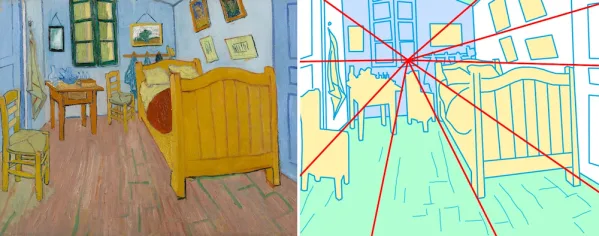
The artist takes a collection of objects and oh-so-carefully positions each object in a pre-calculated relational space to the other objects in their scene. What you end up with is a scene that is locked into one perspective, not even acknowledging the existence of any other possible standpoint for that scene (or event, or experience). One perspective wholly defined by one person and presented as The Only Perspective that exists and can be had for everyone else.
Sight is related to projective geometry, the geometry first studied by Renaissance painters in their attempts to understand perspective. In projective geometry, there are no parallels. Any two lines in a plane meet in one point, and similarly any two points belong to one line: there is a perfect duality between the concepts of point and line.
"The Waltz of Reason: The Entanglement of Mathematics and Philosophy" by Karl Sigmund
There is a flip side of perspective and its relation to parallel lines and it is a wacktastic trick of the eye.
It’s known as the vanishing point and it makes you think you are seeing something that, actually, is not factually as it appears to be upon first sight.
In perspective drawing, parallel lines meet at a “vanishing point.” This is a bit of a downer if your definition of “parallel” is “never meeting”.
"Once Upon A Prime: The Wondrous Connections Between Mathematics and Literature" by Sarah Hart (pg. 74)

Yes, that’s the beginnings of the vanishing point that you’re seeing at the end of that long hallway. Yet… those walls are indeed parallel to each other so… why?
What’s happening is that as two objects that remain in fixed parallel to each other move away from you to a point on the horizon that is as far away from you as they can go, your brain interprets those objects as not only being smaller than they were when they were directly in front of you (though, of course, the actual size of those objects didn’t change) but your brain is also deciding that the angle of it in relation to everything in parallel with it is now taking up less space. Our brains are legit messing with us.
When I knew I wanted needed to write in order to process all of this, I sat down to read (instead of sitting down to write). This* is what pulled it all together for me.
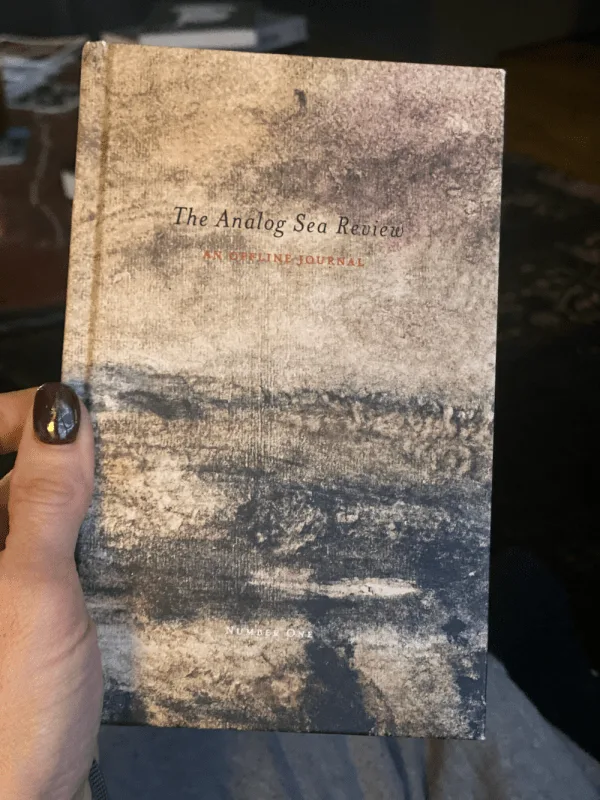
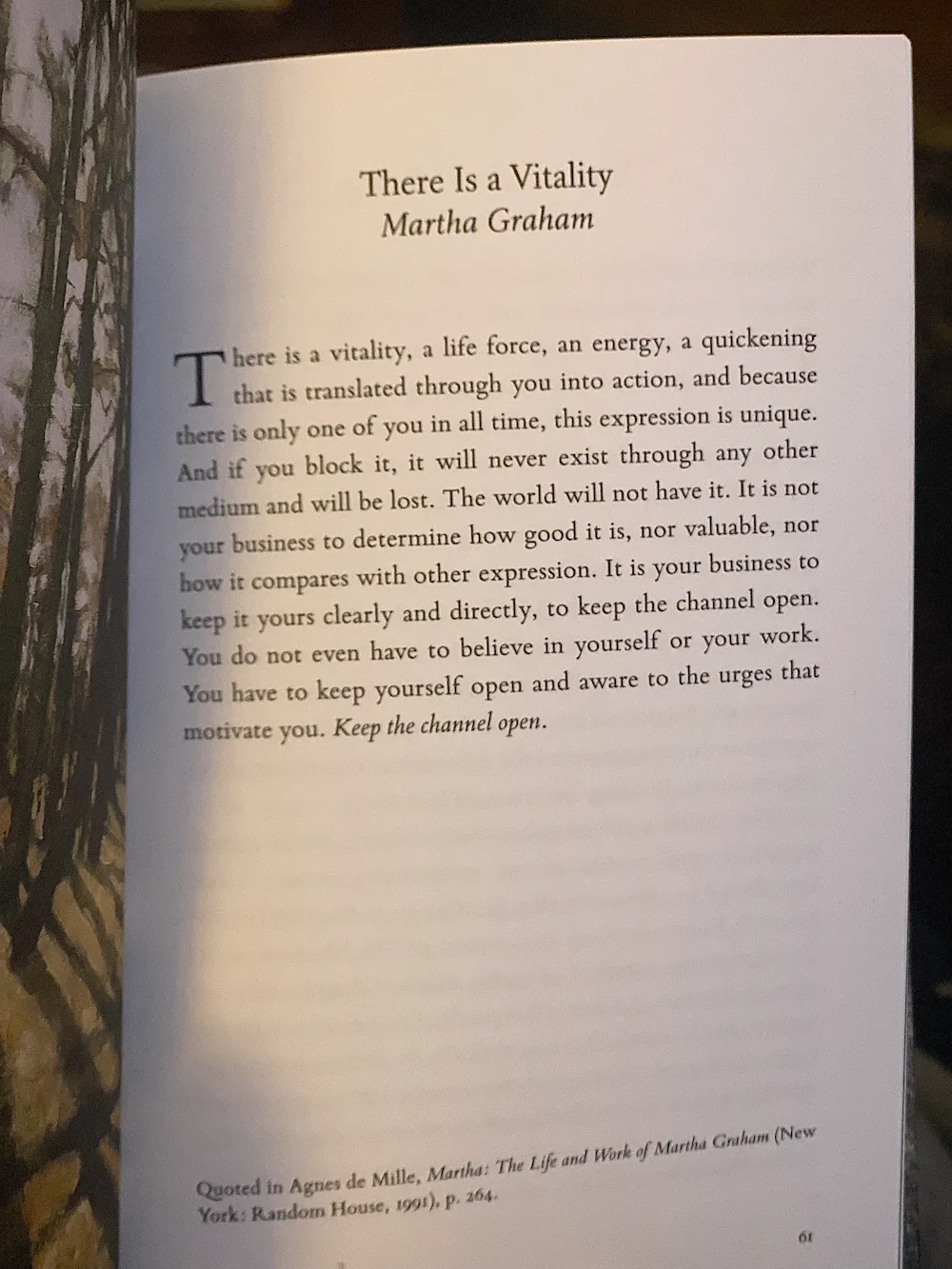
Our perspective is a significant part of our individuality and if you keep on keeping on* - if you #KeepThatChannelOpen - you'll be primed and much informed by that perspective when you are ready to take action.
This geometric visualization of how we move - together - through the good and the bad is the reality of how we interact with each other, as opposed to how we wish we could be, or think we should be, with each other. We are on parallel paths as we process the same experience, allowing ourselves to shun any guilt we may feel for not reacting in the exact same way at the exact same time as those around us. Our vision is affected by this parallax as we orbit along on our unique paths, and that's good because no individual among us can possibly see all the viewpoints that need to be considered for informed decision-making. We'll remain alert to fools who dictate that their perspective* is not only fact but is also the only perspective to consider. And never ever ever forget that that far-off 'vanishing point' is just your mind playing tricks on you; keep the important things (and people) in sight so that your tricky mind doesn't falsely shrink their importance.
No better way to put a bow on this than ⤵️
Artists and mathematicians continued to develop the rules of perspective while looking for ways to best represent space and distance.
"The Princeton Companion to Applied Mathematics" (pg. 945)
Artists and mathematicians make the world go round, yo.
Thanks, math, you’re the best.
Share this essay