The Complex Sensitivity of a Strange Attractor
Where we learn that the changes in our life's trajectories start with itty-bitty baby steps
Attraction. What is that feeling? It’s definitely an abrupt change in energy and it feels like an electrical charge has formed some sort of connection between you and something - or someone - else.
And it’s imbued with positivity, right? It brings on curiosity. I want more of it. I want to look at it again or even go towards it to get confirmation that that first jolt of goodness actually happened and that that connection can be re-lived, that it wasn’t a one time thing nor a momentary zap, it’s an actual ⚡️jolt⚡.
Then, contrary to this type of attraction would be something along the lines of bad vibes, that type of energy that is significant enough to make you pause as you feel that change of energy but… you’re not interested in re-living it and, upon reflection, you might even have a physical I-wanna-shake-that-off and (sub?)consciously not engage with it, ever again.
So if you port those two rather visceral experiences into the math world, specifically with nonlinear dynamics - a focus of study that I briefly pogo’d into when I wrote about equilibrium and chaos and, oh yeah, fractals - you’d come across these things called attractors.
We can generalize an attractor as any state toward which a system naturally evolves. For example, biological fitness is an attractor toward which species evolve.
"Attractors: Strange and Otherwise"
James Madison University
Think of them as a mathematical structure that is repeating a new pattern of movement through the stages of a whole dynamic system; it’s a trajectory shooting on through a vector field. As that trajectorial movement stabilizes itself it becomes the characterization of the behavior of the system.
An attractor is simply any point within an orbit that seems to attract the system to it.
"Chaos Bound: Orderly Disorder in Contemporary Literature and Science" by N. Katherine Hayles (pg. 147)
In other words, it’s the system itself that becomes attracted to that movement that the attractor is putting out there; the system practically conforms to what (or who?) it is as dictated by the attractor, and the impact that the attractor has on that system is a huge part of its identity.
This kind of regular final behavior (either fixed point or oscillation) is called an “attractor” since, loosely speaking, any initial condition will eventually be “attracted to it.”
"Complexity: A Guided Tour" by Melanie Mitchell (pg. 29)
Ah yes, there’s that important conditions thing I’ve brought up before, that place that has requirements for anything to be able to not just exist but to thrive within it.
Well, in the case of an attractor, the point at which they get strange is when some tiny change occurs within the condition itself, a barely perceptible and likely unpredictable alteration of a sort that pokes (not shoves) that attractor just enough off-course that its trajectory now changes and, after some revolutions, settles into a new pattern.
The attractor, that behavioral characteristic of that dynamic system, grrrrl -- she gone and gotten stahrannnnggge 😯🫢😏
Let me offer an IRL example of the impact of a strange attractor on a system (tho, please note, it is not an example of how an attractor becomes strange, so, grain of salt and all that):
Have you ever developed a blister from a pair of shoes, but dammit, you like those shoes so you power through the oweee of the blister? Through the day, bit by bit, your walk (cycle 😉) will change as you compensate for said oweee. If those shoes were then to become your forever-only pair, well, think of how - after a period of time - what that permanency would mean for your body and about you. This would be the way you walk now because your knees and hips would also fall-into-a-line of adjustment due to said blistery oweee. This would be more than some temporary change.
It was the understanding of chaos that eventually led to rest the hope of perfect prediction of all complex systems, quantum or otherwise. The defining idea of chaos is that there are some systems - chaotic systems - in which even minuscule uncertainties in measurements of initial position and momentum can result in huge errors in long-term predictions of these quantities. This is known as sensitive dependence on initial conditions.
"Complexity: A Guided Tour" by Melanie Mitchell (pg. 20)
Attractors exist in complex conditions. And our lives have always been complex.
Though it may seem like that’s become more obvious of late. Or it may be that things have become more complicated - which is not a synonym to the word complex.
In any case, we all live in a complex system, and in complex systems there are behaviors a’happen galore. In many ways our complex system is also deterministic, since the state of what is currently happening has some rigid dependency on what happened most prior. On top of that, it’s also a dynamic system, because we’re just a bunch of organisms interacting with each other in a space where things constantly change, moment to moment.
The primary characteristic of a complex system is that there are multitudes of interactions occurring - which then means there are mega-multitudes of possible outcomes from all those interactions. The emergent behavior (that's how this would be labeled in the math world) that serves up what is definitively a strange attractor is actually something that you could track back and identify it's initial peek-a-boo moment due to its sensitive dependence on its' initial conditions.
You can totally see examples of this in modern times. Climate change? Oh yeah, you know there was a bunch of strange attractor’ness burping up all over that. And in business and industry? Vrbo and Airbnb volleyed and stair-stepped the navigation of home-rental vacation properties to a place that, even through a global pandemic, certified the sustainability of an industry that didn’t exist in the 20th century. Think of what the strange attractor clues were for all of that to become what it now is.
…Real corporations are as much strange attractors as they are hierarchies. They are as much open, nonlinear systems - tied inextricably to the environment that gave them birth, subject to the fluctuations of that environment and the personnel flowing through them - as they are power centers. In fact, subtle influences and chaotic feedback are constantly at work within organizations.
However, after a time the organization falls prey to the grip of the standard “good business” assumptions and begins to petrify. Eventually, competition, hierarchy, and power begin to dominate the organization’s activity. Negative feedback loops controlling the way things are done become reinforced, and soon the organization’s strange attractor is reduced to a limit cycle.
"Seven Life Lessons of Chaos: Timeless Wisdom From The Science of Change" by John Briggs and F. David Peat (pg. 71 and 72)
So. To recap, here we all are, living in this complex, deterministic, dynamical system together, and sometimes things - sometimes some behaviors that we encounter - can get downright strange. Annnnd they’ll continue to seem strange.
Until!
Until… well, until they don’t seem so strange anymore. Most folks will get used to them. The behavior that was once looked at as strange (or unusual, or unexpected, or unconventional, or even surreal, or wacky, or baffling)* - it eventually, once it’s repeated over and over again and it definitively becomes a pattern of behavior and it’s absorbed into the everyday and, eventually, it just becomes the norm, well my dears, that’s a Strange Attractor.
But consider this: what may feel like a bad vibe to you may feel like an attraction to someone else. 😣
In Germany Otto Rössler, a nonpracticing medical doctor who came to chaos by way of chemistry and theoretical biology, began with an odd ability to see strange attractors as philosophical objects, letting the mathematics follow along behind. Rössler's name became attached to a particularly simple attractor in the shape of a band of ribbons with a fold in it, much studied because it was easy to draw, but he also visualized attractors in higher dimensions - “a sausage in a sausage in a sausage in a sausage” he would say, “take it out, fold it, squeeze it, put it back.” Indeed, the folding and squeezing of space was a key to constructing strange attractors, and perhaps a key to the dynamics of the real systems that gave rise to them.
Rössler felt that these shapes embodied a self-organizing principle in the world.
"Chaos: Making A New Science" by James Gleick (pg. 141)
I’m fascinated by the subtlety, and then the absolute power, and eventually the deep impact that strange attractors possess; on the people, on the environment, on everything that’s on their (new) trajectorial path in whatever complex system they’re bee-boppin’ around in. It’s where all the action is, all the action that really matters. They are harbingers of change – and for change!
It was the image of a strange attractor that first got me, that made me do a double-take. In mathematics, strange attractors can be mapped and seen as a geometric shape and their transition through their stages is often likened to dough that is stretched and then folded back on itself, then stretched, then folded, etc etc. This action also exemplifies why many of them can also be called fractal attractors since - if that chunk of dough was then sliced crosswise - you just might see the structure of a scaling fractal pattern: an ever diminishing scale of geometric self-similarity.
I just love looking at the shape of the Rössler Attractor. Of the hundreds* of strange attractors that exist, this is one of the simplest because "it is reduced to the minimum requirements necessary to exhibit chaotic behavior." There are relatively few steps in its equation.
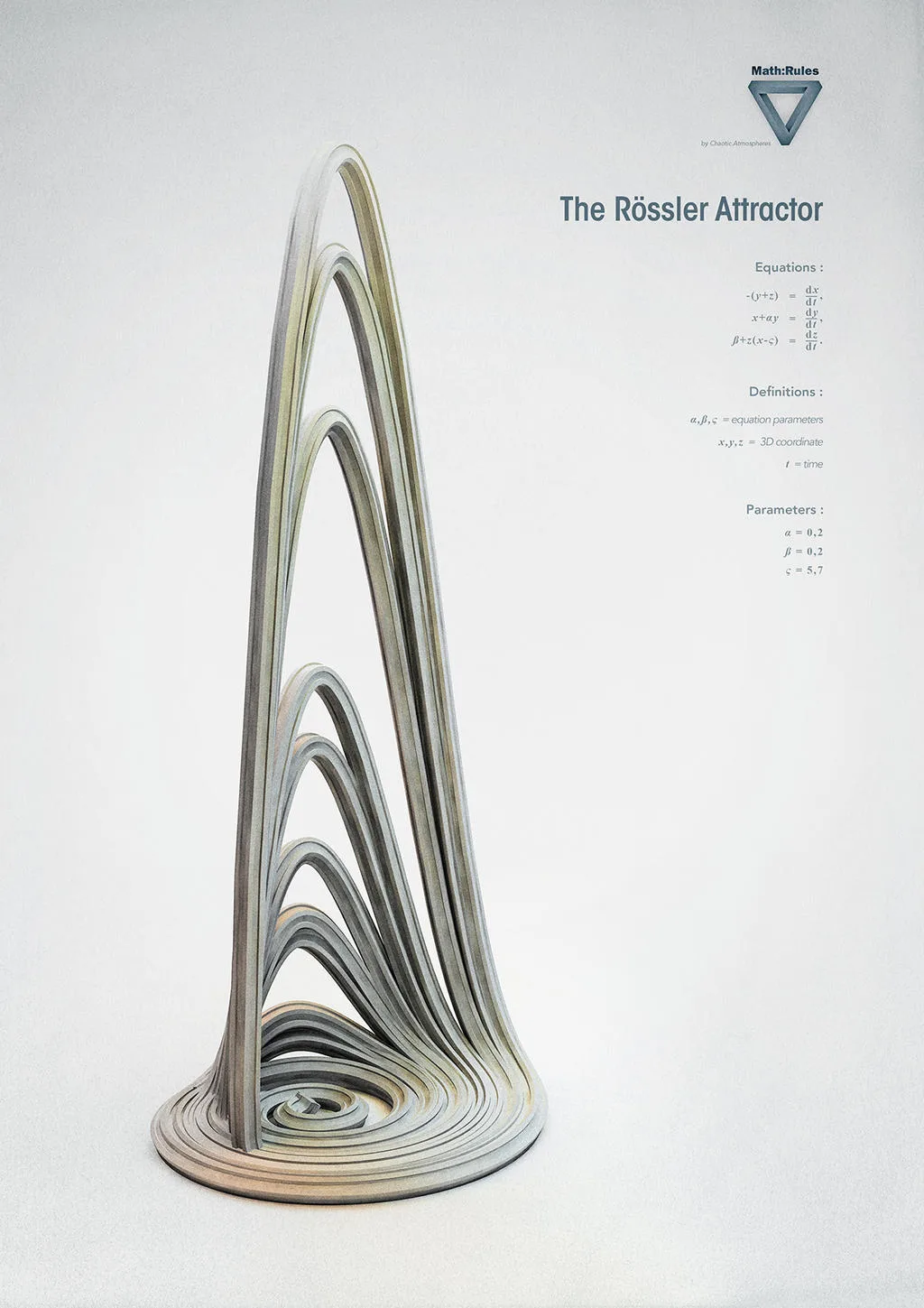
From the Strange Attractors collection of artist ChaoticAtmospheres, where 3D interpretations were made as a "tribute to mathematics."

And here's my tattoo of it. It's a beauty, isn't it?
What follows are a few excerpts from an interview with Rössler. He frequently references a taffy puller machine as a way to visualize the onset of chaotic behavior and, therefore, the genesis of the strange attractor that has his name attached to it. Just take a moment to marvel at what ricochets around in his mind; he is arguably a bit obsessed and hyper-focused and majorly immersed in all things math and science.*
Watching evolution in action is much like taffy-pulling.
The taffy puller is a wonderful example of a chaos-producing machine involving stretching and folding in a repetitive form as in a cross section through an attractor. It looks miraculous if you can watch such a machine in a sweets shop. Everyone would expect if asked that some taffy should fall off and that the whole thing would disintegrate, but it does not, it works for hours and months on a stretch. It is an example of chaos.
"Chaotic Harmony: A Dialog About Physics, Complexity, and Life" by Ali Sanayei and Otto E. Rössler (pg. 73 and 209)
I’m just tapping the surface of these taffy pulls of behavior. There’s so much more to see when you consider the relational aspects begat of these attractive dare I say magnetic bursts of newly emerged behavioral patterns. If you’d like a hint of more of things to come when a strange attractor really takes root –well, please do read Chaos Is Just A Misunderstood Twerp.
Thanks math, you're the best.
Share this essay