Mathnificent Word of the Week
Originally posted on
August 26, 2025

Photo by raditio ghifiardi on Unsplash
clique
/’klik/
noun
Within a multi-node graph, the largest closed subset that has at least 3 nodes where every pair of nodes has mutual connections.
“Once Maggie knew she was dealing with a 7-node clique, not a 7-node group, she knew the information flow would be different.”
Photo by raditio ghifiardi on Unsplash
Cliques or groups – which do you prefer?
There are cliques and there are groups and the two of them just aren’t the same – especially if you look at them through a mathematician’s eyes. Yet, as in life so it is in math, because the definitions of each of them in each of those worlds can be worded very similarly.
Groups are a set of numbers or a set of people that have something in common, something that dictates the arrangement of how those numbers or people are gathered. Cliques are basically groups that have one additional and very specific characteristic: Graph Theorists would say cliques are closed while many of us might use the word exclusive when talking about them in real life.
Though that common definition of a clique might elicit a negative connotation, decrying that others may not so readily join them, that exclusivity can actually be helpful in both math and life when a clique is to be analyzed, especially if looking for conclusive findings.
You can read the definition (above) but the quickest way to understand what they are is to look at a visual of a graph:
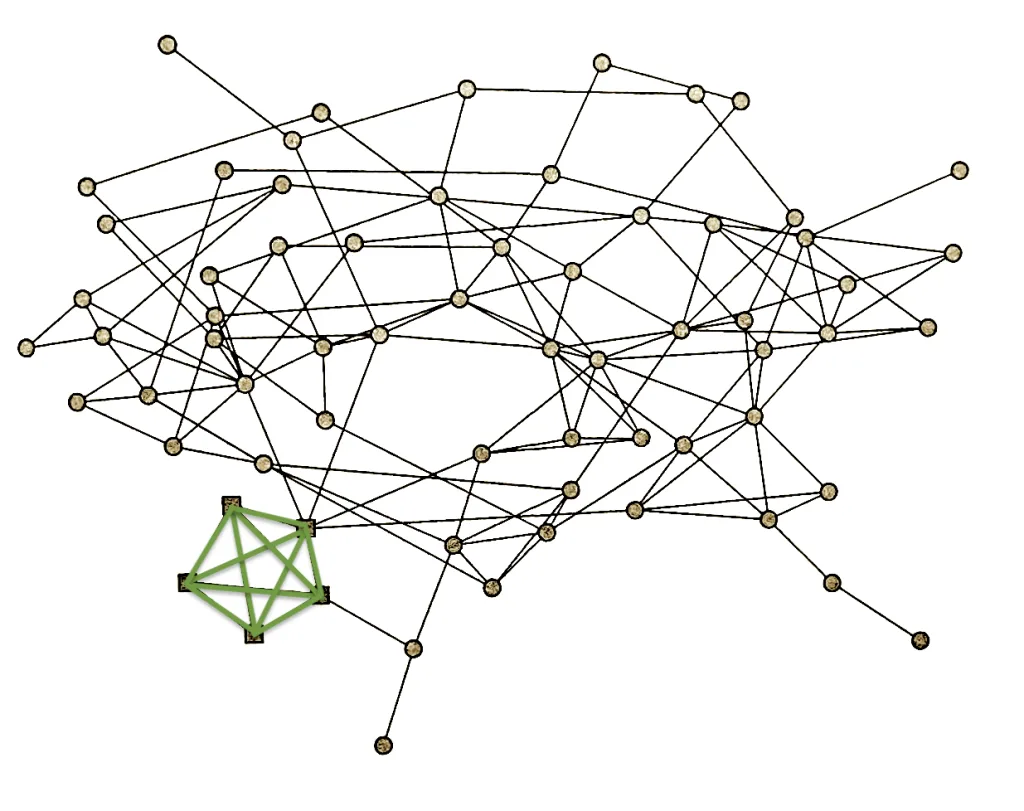
Image: “Structure of Complex Networks” pg. 17
That highlighted part is the clique, aka a closed subgraph, where in this case each of its 5-nodes (aka points aka vertices) are not only connected but they also each share at least one connection with another node. To translate that to real life, just swap the nodes for people and the line segments for their individual relationships.
The rest of that graph would be considered a group (of nodes or people) but I don’t believe there are any other true cliques within it.
With a group analysis, there’s so many “opens.” Like, if a node/ person goes away, then that line segment / relationship is left behind, dangling. Which might be a good way to track a leak – of water, or information. But, there’s just a few too many opportunities for inconclusive findings.
Share this Page