Measuring A Relationship By Its Dimensions
Where we learn that our perceptions are intimately linked to our intuitions.
While sitting at my neighbor’s house, at their dinner table, eating the food that they had prepared - with care - for us to all enjoy together, I tuned into the energy that our host projected as she very directly asked what we thought of the “horrible incident in Pennsylvania” that had happened the weekend prior.
We all paused for a moment.
We live in a small coastal town that is packed with visitors in the summertime. The residents of our six block nook of a neighborhood are primarily full-timers, folks who live here year round and who work in all types of industries - hospitality, medical, emergency services, city workers. They are business owners. They are hourly wage workers. They are retired. Many are Christian and have strong faith. They reside in this place for many years, raising their families here.
Though my spouse and I reside here for most of the year, we also have a home in the city that’s 1.5hrs from here - which means that sometimes we’re away from our small town home for a handful of weeks at a time. But since we both just do better as humans when we are able to go touch the ocean on any given day, and we’re fortunate at this point in our lives that we can work remotely, we’re here more than there.
The energy in the room at that moment at the dinner table wasn’t negative. It just felt laced with hesitancy. There was the slightest vibration of fragility mixed with a solid presence of The Now. I think we each wanted to be gentle with our words.
And my anxiety did a little spike in that very moment, having learned during pandemic times that the belief systems of those of us in that room do not align (though hot damn they are good neighbors, where good neighbors = mutual safety & privacy & compassion for each other’s well-being).
I started thinking about the dimension of my relationship with each of them. Not depth, but dimension.
Roughly speaking, the dimension of a shape is the number of independent directions one can move about in while staying inside the shape…
For weeks now, I’ve been pushing out short diddies on the socials - mostly about points and lines,* fully intending for that to then lead me to dimensions.
Well, I got there - to dimensions - while sitting at my neighbor’s dinner table. And getting there has helped me navigate my own emotions without compromising my strongly held beliefs, all in service to me leading all my interactions with anyone & everyone with grace and respect. At least, I hoped that was where I had landed.
Fully understanding the definition of dimension and applying that to how you look at all the different relationships in your life eliminates the need to prioritize - or rate - one relationship as being more important, or more valuable, or as being better than any of your other relationships.
I’m not dismissing the value of depth in relationships. I just want you to equitably value the dimension of your relationships, and give it its well-warranted props.
Here’s a breakdown of my overlay - my mapping - of what I envision in those dinner conversation moments, moving from point to line to dimension.
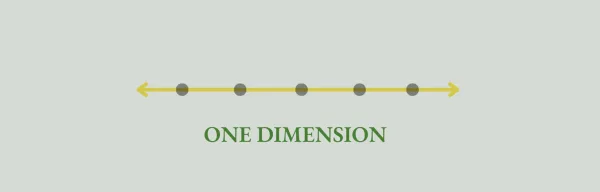
If you know that the primary way to define a point is by its own position in space, and a (straight) line is then a series of points lying evenly one after another, then you can recognize how a line, in and of itself, encompasses just dimension. One straight line is not going to have multiple directions.
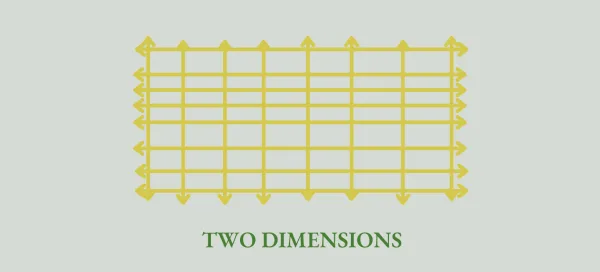
You get to two dimensions when there is more than one line present, where those series of points that make up those many lines are going in multiple directions. Yet, those lines remain on one flat plane. They are lines that are lying evenly with each other. All those lines together are a range* which is, fundamentally, also referred to as a surface.
Then! Then those surfaces meet-up. Well, the edges of those surfaces meet up and, significantly, when the edges of a bunch of surfaces all get together and the very tips of their edges meet-up, that’s when they have the potential to enclose a space and, subsequently, the representation of that space itself is what we refer to as three dimensions.
In three dimensions you can visualize that there’d be lots of lines going in lots of directions, where each of those lines are made up of lots of points - and these lines are lying on a bunch of different planes.
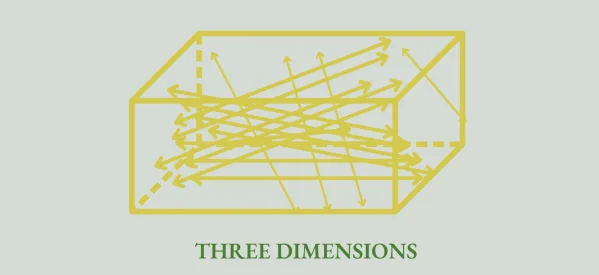
But! But those lines have now been enclosed.* They are now contained. {phew!😉} If you want, you can picture that enclosure as a shape of some sort. If I stare at and think about this too much, my brain starts tripping a little, because now I’m talking about looking at something that has three dimensions but you’re seeing it on a two dimensional surface. 😒
I find comfort in knowing I’m not the only one to kinda bug out on this. Here's Plato’s take on it.
In Book VII of his work Republic, Plato used the allegory of the cave to express his concept that there is a connection between looking at an object and understanding an object. When looking at a picture of a box, there is an understanding that it is an image of a box, but it is not literally an actual box. Instead, it is a two-dimensional picture of a three-dimensional box. People make sense of that image because they see how it participates in the form of a box. Thus, according to Plato, humans base Reality on an idea of an object, but not the actual object.
"Hypatia: The Sum of Her Life" by Gabrielle Birchak (pg. 116)
Thanks, Plato. Your concept is how I can spatially transfer my understanding, and application, of dimensions to the construct of a relationship IRL.
True to all applications of #mathIRL, though: this dimensional way of thinking about the relationships in your life is not only very subjective, but also - very conditional, because you can never forget that humans are the most variable of all the variables to exist.
All applications to the physical world are complicated by the inherent noisiness of nature.
"The Geometry of Grief: Reflections on Mathematics, Loss, and Life" by Michael Frame (pg. 135)
Like, sure, you might be 💯 that a particular person that you have a relationship with will disagree with you on a specific point. But, would you place a bet on how they would then react in that moment of disagreement? Maybe they’d get quiet or loud, or sad or anxious, or violent or retaliate or…🤨 It’d all depend on what conditions they themselves are in at that moment – and it’s highly doubtful that you would know the entirety of that info.
One of Nietzsche’s more notorious doctrines is perspectivism - the idea that we are condemned to see the world from a partial and distorted perspective, one defined by our interests and values… Nevertheless, [Simon] Blackburn accuses Nietzsche of sloppy thinking . There is no reason, he says, to assume that we are forever trapped in a single perspective or that different perspectives cannot be ranked according to accuracy. And if we can move from one perspective to another, what is to prevent us from conjoining our partial views into a reasonably objective picture of the world?
"When Einstein Walked With Gödel: Excursions To The Edge of Thought" by Jim Holt (pg. 340)
You probably are, though, intimately aware of your own human instincts - namely, your own intuition. Intuition and its close mate - perception - are the fluid ways you can dial the length of those lines of dimension within the shape(s) of a relationship(s). This is where your responsibility and personal control live in any relationship; your own input, not someone else’s output that’s in reaction to your input. Does that make sense?
In reference to the definition of dimension that I started with at the top of all this, let’s apply that to when you’re blowing your breath into a balloon. You are the one who has control of how much you want to expand – or, at times, release - your ‘breath’ of engagement within the entirety of any relationship. Whether you’re at a neighbor’s dinner table or in a business meeting, that breath is driven by your intuition and perception in those very moments of interaction.
Does your balloon-blowing-breath 🌬️🎈want to engage further, ask questions (leading or otherwise), or blurt out your knowledge or an opinion? Or do you want to pause, maybe even release a bit of that balloon’s dimension by simply acknowledging what the other person’s saying?
Again, this is not about altering the depth - it’s not about how deep you go in building the elements of a relationship. And it’s also not the flipside of that - it’s not about the shallowness of a relationship; both of those are also verrrrry subjective judgements made by each party within a relationship. What feels like a deep relationship for any of us is gonna be based on our own individual experiences of the other relationships in our life, you know?
Personally, when I think about the depth of a relationship, I invariably picture it like digging a hole in the sand. There’s actually a fair amount of work - of emotion and maybe even personal labor - that goes into changing the depth (in a relationship or a hole in the sand) once it’s been brought into existence, what with having to pick up the weight of the sand that was distributed all around that hole, and then refilling it...* Yuck.
Perception guided by intuition is your go-to-guide when deciding if you’re gonna expand on depth or if you’re gonna expand on dimension in a relationship.
Here’s one last bit to think on.
…an important truth about human beings and the first principle of individuality: the jaggedness principle. This principle holds that we cannot apply one-dimensional thinking to understand something that is complex and “jagged.” What, precisely, is jaggedness? A quality is jagged if it meets two criteria. First, it must consist of multiple dimensions. Second, these dimensions must be weakly related to each other. Jaggedness is not just about human size, almost every human characteristic that we care about – including talent, intelligence, character, creativity and so on – is jagged.
"The End of Average: How We Succeed In A World That Values Sameness" by Todd Rose (pg. 82)
I believe it’s really important to develop past one dimension in any relationship, even though I totally get that that may require more energy from you than you may have or are willing to exert towards another human being. But there’s something really powerful about that ‘jaggedness principle’. It’s true that the individuals that are the characters within a relationship are complex, which in turn kinda sorta just makes even the most casual of relationships complex as well.
So, making even the smallest of efforts, blowing even the tiniest bit on that relationship balloon to allow for not just two but three dimensions to develop – like, sharing that puzzle you just finished with that neighbor that you know likes doing puzzles - stuff like that is what acknowledges that you see the individuality in that person, and it gets y’all out of existing in a surface* relationship.
Thanks math, you’re the best.
Share this essay