What's My / Who's My / Where's Your Line?
Where we learn that math, art, and war can bang up on each other.
I write about math IRL because I can’t wrap my head around things like ceasefires.
Any process or system that I can’t intuit leads me to search my mind’s archives for a relatable experience that I might use as tracing paper. It’s the only way I can actually sink in to fully understanding the haps of the what’s up. Attempting to wrap my head around this concept of a sudden and absolute pause, one that in no way could be mistaken for a full stop, but a true pause-only in an action which absolutely intends to reanimate asap, well, what popped into my head was when I’d play stoopball as a kid.
Stoopball* is played in the street, and if someone yelled, “CAR!” then the rest of us would mumble-yell “Game Off” as we walked to the closest curb so that said car could pass and then - with a little more gusto - we’d yell, “Game On!” as soon as the street was clear.
Sometimes we could play for 10 or 15min before a car needed to come thru, though that would totally mess with the cadence of whatever was going on right at that point of the call/response holler of “CAR!” “Game Off”.
So if the bellow for wartime “Game-Off’ is ceasefire, what’s the “Game On” equivalent? “Resume fire”? “Back to war we go!” “War On”?
The time has come where I welcome you with open arms and - maybe even a hot toddy, cuz there’s a chill in the air - as you travel along a synapse connection path of my brain, because it’s at this point in my thought process that I had landed on lines as my writing focal point.
Yup. Street lines, border lines, curb lines. Lines.
Which then (of course!) put me in B.C. times, where a math-obsessed Greek dude named Euclid offered up this definition:
The extremities of a line are points. A straight line is a line which lies evenly with the points on itself.
"The Thirteen Books of Euclid's Elements - Vol. 1 (Books I and II)" by Euclid translated with introduction and commentary by Sir Thomas L. Heath (pg. 165)
Yup, take me to the basics, and there’s not much of anything more basic in the land of mathematics than talking about lines; they’re one of only two residents in the realm of one dimension.
“This definition,” says Proclus, “is a perfect one as showing the essence of a line; he who called it the flux of a point seems to define it from its genetic cause, and it is not every line that he sets before us, but only the immaterial line…”
"The Thirteen Books of Euclid's Elements - Vol. 1 (Books I and II)" by Euclid translated with introduction and commentary by Sir Thomas L. Heath (pg. 159)
...that other resident being a point (which I defined in the Math WoW: Point of May 23, 2023 as "A point has no depth or length - the only thing it has is its defined position.") and many points begat a line, because - according to Proclus, a 5th century Greek philosopher - a line is a “flux of a point, i.e. the path of a point when moved."
Ok, so, just a line that has no intentions nor any, well, point 👈 or purpose or job or whatever. It’s just there living its best one dimensional life.
The first dimension, the line, comes into being as the One emerges into two principles, active and passive. The point chooses somewhere outside of itself, a direction. Separation has occurred and the line comes into being. A line has no thickness, and it is sometimes said that a line has no end.
"Quadrivium: The Four Classic Liberal Arts of Number, Geometry, Music and Cosmology" by Miranda Lundy (pg. 64)
Allright, well, that’s a bit dramatic, Miranda 😘, but I totally love when some passion of importance can be injected into any math explanation. I might argue on that middle bit - with the point choosing a direction - because only arrows choose direction, and arrows go on a line, never on a point. (check out the ending section of this essay).
As you marinate in all of that, I've got a(nother) Kate-as-a-kid story to share with you.
Sunday night was bath night for me. It was also the night that my mom would call her dad. And she’d call him from my parents bedroom, sitting at the secretary desk next to the bed, on the long-corded (rotary, natch) phone* that I would later beg to use as a teenager when I wanted to have some privacy 🙄omg leavemealone I'm on the phonnnnnnneee.
That bedroom was all the way at the opposite end of the hallway from the bathroom where I was sitting in a bathtub, a hallway that seemed incredibly long in my memory, with two other bedrooms and another bathroom in between - plus a decent sized staircase-landing, the midpoint leading down to the first floor of the home and leading up to the 3rd floor attic / future bedroom of my second oldest brother (~14yrs older).
What is the innate attribute the line is trying to express? An attribute that increases as the line grows? Your thoughts slowly coalesce around the notion of length.
"The Big Bang of Numbers: How To Build The Universe Using Only Math" by Manil Suri (pg. 75)
I can tell you, for a 4 year old, my innate attribute for the length of that hallway was loooong and my mom was faaaaar away. On more than one occasion, the bath water would get cold and since I wasn’t a kid who yelled - I grew up in a quiet home and voice-raising was associated with something b a d going on - I just sat. Pruned fingers and toes.*
And after I had finished thinking about what I would watch on TV after my bath, what’d usually pop into my head while I was waiting for my mom to come back with a big towel to warm me up and dry me off was, well, lines. Seriously. And sometimes shapes. And there might be some colors. All of these on their own with no other context. Probably, initially, the lines would be pulled from the tile I was looking at or the furniture or a toy I was playing with in the tub.
These lines would just be floating in my imagination, kinda stacked but never touching, sometimes spinning as groups but just sections of it spinning while other groupings were sedentary.
Unfortunately, you can not prove everything from scratch; you have to start with a few things which are assumed to be true and see where you can go from there. So Euclid picked the most obvious thing to assume, things so clearly true that they require no justification or evidence…once you accept that lines and circles exist, then the existence of regular triangles, squares, pentagons and hexagons flows as a natural consequence.
"Things To Make and Do In The Fourth Dimension" by Matt Parker (pg. 33)
On July 16th of this year - my 52nd birthday - after getting royally screwed by a late decision to delay the Dodgers away-game* that I was going to go to with my baseball peeps, we ended up at the Guggenheim Museum. And my life was changed forever.
I was not familiar with the artist known as Gego (full name: Gertrude Goldschmidt) and hers was the main exhibit, a version of her seminal Recticulárea exhibit that had its debut over 50yrs ago in Venezuela.
These are some of Gego's written responses to a questionnaire ©1970
Q: What is your approach to your work?
A: LINES IN SPACE
Q: What is the starting point?*
A: LINES
Q: How is your work developed?
A: GROWING from all one line according to a structural system.from "Sabiduras and other texts by Gego" the unpublished texts of the Latin American artist (pg. 177)
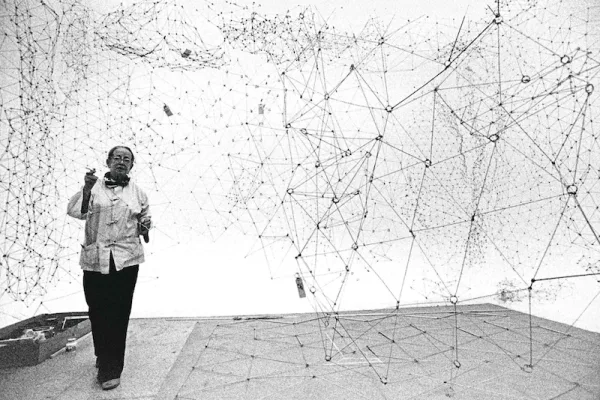
Reticulárea (1969–82) A monumental installation of vertically- and horizontally-suspended metal wires that hang from the ceiling and the walls, creating a constellation of lines and geometric figures that fill the space.
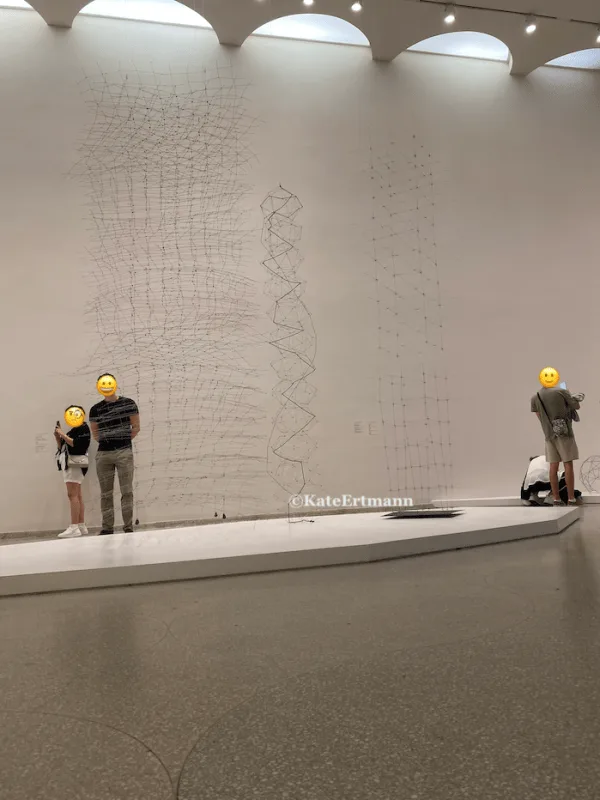
These three color photos are ones that I took, somehow, in the midst of my tears of overwhelming joy.
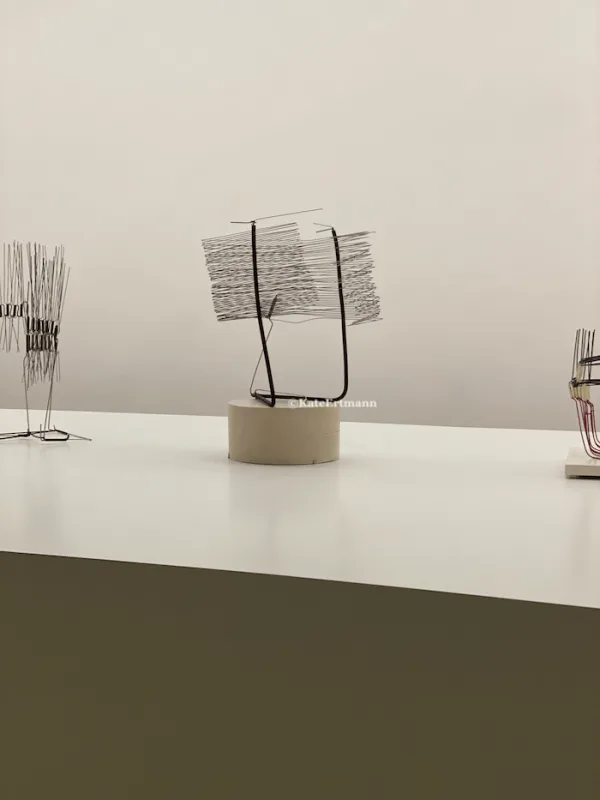
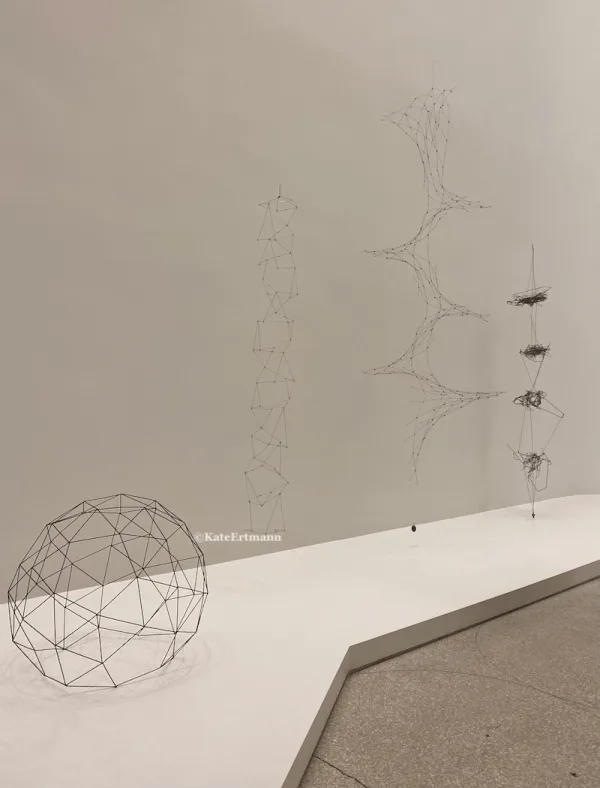
My dears - I have never been so overcome with emotions - especially on-display in public - tears friggin’ streaming down my face, viscous streams of water that were keeping pace with the game-delay raindrops coming down outdoors. I wasn’t just overcome, I was overwrought because the art before me looked exactly like what I saw in my head, sitting in that cold bath water, waiting for my mom to come rescue me and warm me up.
But! There was very little sadness in those tears. I had never desired to artistically realize any of that imagery from my imagination. I also never - ever - stopped daydreaming of it, or about it. It wasn’t something I could call up on command, and I’d forget about it for stretches of time, for sure. I don’t think I ever dream-dreamed about it, like, as I was sleeping. It was just on repeat in my daydreams. For decades. Floating lines.
Line as human means to express the relation between points, something that is entirely abstract in the sense: of not existing materially in nature.
Line as medium
indicates materially
the relation between
points in space,
expressing visually
human descriptive thought.Line as object to play with.
from "Sabiduras and other texts by Gego" - the unpublished texts of the Latin American artist (pg.49)
As an adult, I can make assumptions that my little self innately appreciated the directness, the structure, the definition, the construction of an amalgamation of lines. But that's just a bunch of guesses, knowing what I know now and all the filters that I see my life through as an adult.
Every volume of explanations by or about Gego on her life’s work as a whole, especially this work that she created in the 60’s - 70’s, tells me that we would have had some fantastic conversations.
I get her. I get this explanation that she wrote in the 1960s "when she was studying, researching, and reflecting on the principal expressive elements that interested her, while simultaneously producing a fertile body of work, especially on paper."
And I think she would have gotten me.
In all this reading about lines, I learned that Aristotle denoted:
“broken lines” as forming an angle as one line: thus, line, if it be bent, but yet continuous, is called one.
"The Thirteen Books of Euclid's Elements - Vol. 1 (Books I and II)" by Euclid translated with introduction and commentary by Sir Thomas L. Heath (pg. 167)
Angles, people. Aristotle was referring to what we commonly call as angles - the bordering of those corners in a triangle or a square - that's what he was saying were ‘broken lines’.
Heron, on the other hand:
A broken line so-called is a line which, when produced, does not meet itself.*
"The Thirteen Books of Euclid's Elements - Vol. 1 (Books I and II)" by Euclid translated with introduction and commentary by Sir Thomas L. Heath (pg. 167)
This! This is even better. Heron doesn’t disagree with what Aristotle was putting out there,* he’s just taking it one step further.
Though all these Greek doods of many centuries ago had their own minute way to define the basics, they did all agree that some lines were curved, and some curves were straight, and sometimes that could mean that their ends would meet, thereby enclosing all within.
Further we can obtain sensible perception of a line if we look at the division between the light and the dark when a shadow is thrown on the earth or the moon; for clearly the division is without breadth, but has length.
"The Thirteen Books of Euclid's Elements - Vol. 1 (Books I and II)" by Euclid translated with introduction and commentary by Sir Thomas L. Heath (pg. 159)
It makes sense to me that if you ran with the whole “broken line” definition that Ari* proclaimed, all bets were off and that line - be it straight, curved, or broken - moved up a geometric level and had progressed to the next level in geometric hierarchy since it was officially, now, a bonafide shape.
Leave it to a visual that we have all seen before to really bring it home about lines. A line without breadth, without volume, an unfilled cavity, no great morass. Just a line that shows the difference from light to dark that - let's make note of this significance - can be seen from 300,000 miles away.
Or a line of war. That's clear messaging. A line of formation.
A line doesn’t have to have a purpose but it can have a purpose, and whether it’s a bridge to developing two-dimensional shapes, or it lives as its lone OG self yet exists in a three-dimensional space. Or! It delineates what or who is over here from anything and all that is over there – on the moon or in a war.
OR or, at first, it appears to have a long-standing purpose, but then in the long-term - it never quite gets there. I'm talking about an asymptote line, defined in the Oxford dictionary as "a line that continually approaches a given curve, but does not meet it at any finite distance." It's just like that "Game Off" of a ceasefire, where by its sheer existence there's a belief that - after this pause for safety - a mutually agreeable destination will be reached. Pbft, so rarely does that happen.
...those who journey in a straight line only travel the necessary distance. While those who do not go straight travel more than the necessary distance.
"The Thirteen Books of Euclid's Elements - Vol. 1 (Books I and II)" by Euclid translated with introduction and commentary by Sir Thomas L. Heath (pg. 166)
Oooh, a suggestion of exploration and going off the beaten path. Let's travel the unnecessary line, for that's the only way you could have any chance to see what needs to be seen. And heard. And learned.
Thanks math, you’re the best.
P.S. I suppose if Game-Off : Ceasefire then Game-On : War
Disappointing on a billion levels.
Share this essay