A How-To On Making Triangles Mutually Beneficial For All
Where we learn that it’s all in the angles.
Relationship patterns are my jam. Sure, my understanding of them seeps into my work with all types of systems architecture and the like, but! Where the word systems brings to mind an intricate and (oft presumed) tangled jumble of cables and switchboards and complexity, the sheer root word in relationships conveys that an individual actually has a proportional amount of control of the health of whatever relationship they are a part of.
It’s like systems are a conglomerate happening over there. Relationships are a dynamic happening right here.
An established 1:1 relationship is a dyadic relationship, an isomorphism* where communication is a practice of exchanging information. The next-step progression of this relationship though, where you're taking it a step closer to group communication, would be by adding a third party and then 💥boom💥 - you are now a part of a triad.*
Lots of childhood friendships, at some point, experience the dynamics of a triad relationship, and though my memory may be protecting me in some way, my own experience of it doesn’t hold any exceptional negative moments. First grade is when my friendship with Pattie and Madeline* began, and besides the typical adolescent misunderstandings here and there, the three of us had a special bond that went on into our adulthood.
I realize this is not the typical experience, though, when you (or your group or your department at work) is one of three in a triadic relationship.
Many people can effectively manage a relationship with one other person, but it is more difficult to maintain a balanced relationship with two others — figuring out how to address the subgroup, when to jump in, how to manage potential jealousies. The addition of only one person to a relationship adds considerable complexity, requiring greater empathy, self-confidence, and cognitive complexity on the part of each person involved… Thus, triads are the proving ground and building blocks of group relationships. They are the bridges from dyadic to group relationships, ones that some never manage to cross. When triads flounder, various phenomena emerge, such as triangling or triangulation, a pernicious pattern of relationships that undercuts both dyadic and group relationships.
"Complex Systems and Human Behavior" by Christopher G. Hudson (pg. 381-382)
Taking a cue from that triad bridge metaphor, and since I have a gosh-darn tendency need to develop a visualization for any process that I engage in, this is where my focus brings us to that oh-so-pointy scoundrel, the triangle.
That is, my focus is on its geometry in a way that gives a mathematically supported representation of the impact of a give > < take interaction between three entities.
Triangle (noun) A closed plane figure bounded by three straight lines meeting at three vertices. The sum of the angles of a plane triangle is 180°, and its area is half the product of base and height.
This is a quickee refresher of the Euclidean definition of a triangle.
And just look at the myriad of shapes a triangle can take on, as well as the variance of the inner angles it can assume.
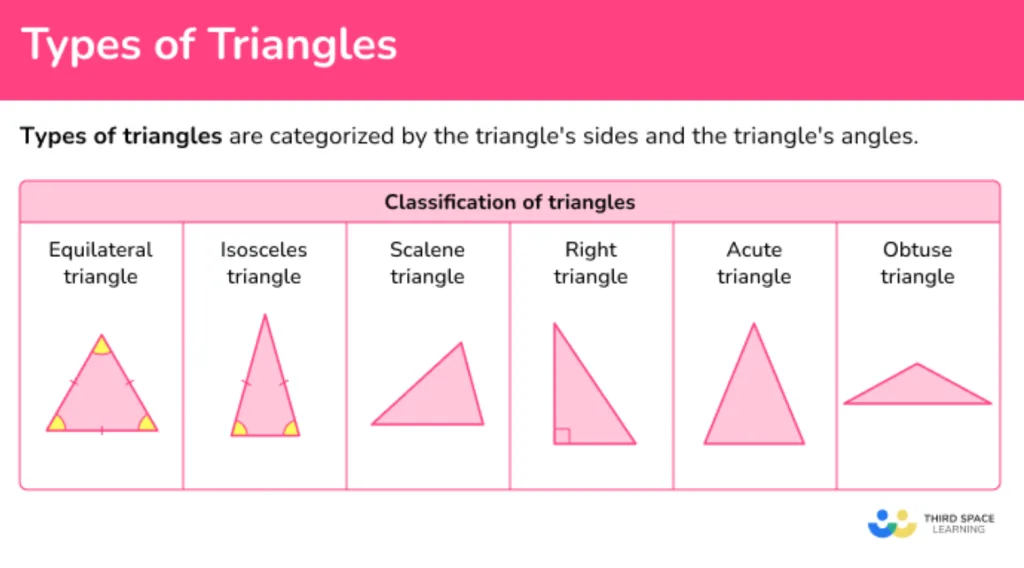
Image from Third Space Learning
The third leg of a stool gives it balance, the third strand of a braid makes a plait (knots can only be tied in three-dimensional space)… The triangle, trinity’s most simple and structural device, is the first stable polygon, and defines the first surface… (and) three is the first triangular number.
"Quadrivium : the four classical liberal arts of number, geometry, music, & cosmology" by Miranda Lundy et al (pg. 16)
Yes, I’ve written about the super’ness of ellipses, yet I also called out “the almighty triangle,” and now I’d like to underline that declaration because {huzzah!} triangles are at the heart of geometry - and that’s because the number three is the password to reaching equilibrium.
Go go triangle, go!
I assume it’s not a stretch for you to visualize a triadic relationship splayed out, well, triangularly. I can easily picture each of the triad’s participants standing at each of the three vertices, looking inward towards the other two participants positioned at each of the other vertices. Now, picture each of the angles as representations of the amount of energy - or maybe it’s a representation of power, or maybe it’s visibility - that emits from each vertex; yeah, go ahead, let’s put a quantitative value that’s in direct proportion to the size of each of those angles.
If I was the one standing at one of the three triangle points, I’d wanna know if it was possible to shift that energy (that power, that visibility)...
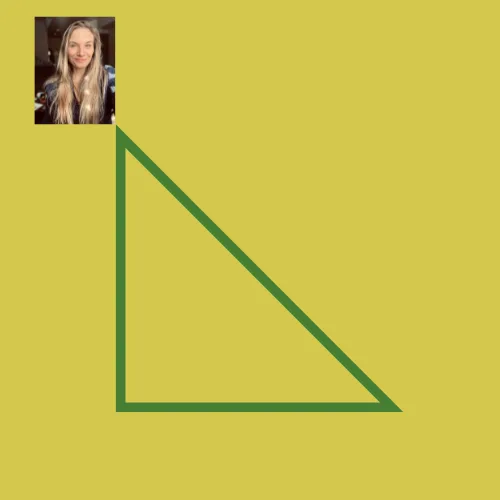
...of what might be a right triangle’d relationship...
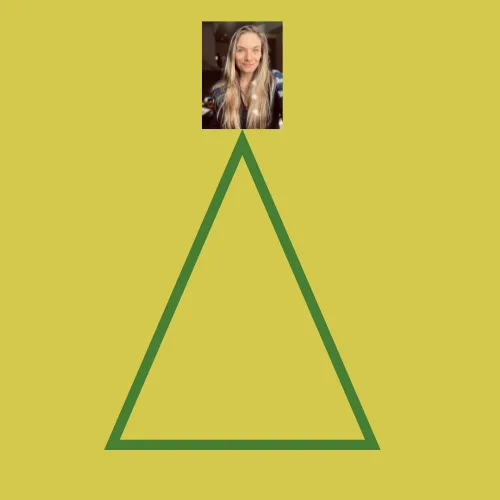
...so it could become an equilateral triangle’d relationship.
I might not need to do that or even want to do that, depending on what my role is as one third of this triad, but since I’m of the sort that likes to plan ahead* for those just-in-case-I gotta-get-outta-here moments, let’s play this out.
One third of a triad can absolutely initiate a shift of that angle of energy, though I’ll fully surrender to the fact that in the process of shifting, things could get very messy. But it can most certainly be accomplished.
In other words, the virtuality of a diagram consists of all the gestures and future alterations that are in some fashion 'contained' in it. A triangle, for instance, does not exist as a rigid figure or as a sign perched in space, but rather it exists as a mobility or set of gestures.
"Mathematics and the Body: Material Entanglements in the Classroom" by Elizabeth De Freitas & Nathalie Sinclair (pg. 205)
If you’re concerned about conjuring up any messiness as you attempt to shift this triad into an alternate triangular shape, I implore you - don’t bounce (out from the triad). That three-legged stool of a relationship not only has built-in balance that could never be attained by a dyadic relationship, but a key component - and benefit - of being able to maintain balance is that some weight from one third can be distributed onto the other two.
Roughly speaking, players can either be affected by a diffuse feeling of indebtedness – “Somebody helped me, I feel elated and therefore will help another person,” — or else, they can be moved by a feeling of appreciation – “My co-player acted graciously, not to me but to another person, and I will now help my co-player in return.”"The Calculus of Selfishness" by Karl Sigmund (pg. 82)
I’m realizing that this angle-shift I’m proposing is - as exemplified by my imagery above - coming from the viewpoint of a person standing at the less-than-90° vertex. Of course, an angle-shifting could be initiated by someone at the more-than-90° vertex, due to some sort of 'event' like a reorganization or the unexpected absence of one-third of the triad. In those sorts of circumstances, there can be mutual benefits that might result from changing the angles of this triad/triangle you find yourself a part of.
Sometimes there can be indirect reciprocity, a vicarious alt-version of mutualism.
There’s one more slice of goodness to share about a triangular relationship, a goodness that, though it can be reached in a dyadic relationship, can’t quite get to the level that a triad can produce. Of course,* I’m talking about harmony.
The major triad, which occurs naturally in the harmonic series as a pair of thirds (a major, then a minor, adding to a fifth), is the foundation of tertial music (chords constructed in thirds) around the world, the perfect fifth and major third being, after the octave, the most stable and resonant intervals, derived from the overtones.
"Quadrivium : the four classical liberal arts of number, geometry, music, & cosmology" by Miranda Lundy et al (pg. 256)
I’ll admit that it’s not any ol’ triangle that represents - and presents - as a harmonic entity; you can’t be willy-nilly with the amount of angle that your vertix is representing and expect it to be in harmony with the other two thirds of your triad; not all triadic relationships are automatically designated as being harmonious. It’d be tone-deaf to make that assumption (I know I know omg 😂 I am very punny🤓🙄).
But I do believe it’s essential to remember this characteristic of a triangular connection of entities.
The primary difference of harmony versus sync is that individuality is a paramount characteristic for each component. Whether the three parts are singing together or working together, the way that the sweet sweet blending of parts brings joy, brings success, is due to the precision of their complimentary offerings. That pattern that brings balance to all.
Yet mathematics shows us the possibility of learning more through the concepts of proportion and relation concerning what is beyond our reach than if we did not consider what mathematics teaches us about harmony and mediation.
"Weaving The World: Simone Weil on Science, Mathematics, and Love" by Vance G. Morgan (pg. 138)
Thanks math, you’re the best.
Share this essay